
Utility analysis: When is it useful in supplier evaluation?
When dealing with sourcing events, purchasers are regularly facing a key question: How can criteria such as quality, adherence to deadlines, service, or ESG requirements be evaluated in a structured process alongside the price? The real challenge is to weigh different dimensions, balance priorities between departments, and document the decision in a comprehensible manner. This is precisely where a utility analysis comes in handy: It offers a clear method for structuring and weighting criteria, thereby enabling a well-founded decision on suppliers.
Utility analysis explained simply
Utility analysis is a method for systematically evaluating several alternatives based on various criteria and weighting them. This creates a transparent basis for decision-making – especially when there is more at stake than just price.
💶Price comparison – indispensable, but with limitations
The price comparison list provides transparency regarding prices and conditions and forms the basis for every procurement decision.
But he only answers one question: Who is the cheapest? That is not enough for a comprehensive supplier evaluation.
📊Scoring models – fast, but often inaccurate
Scoring models enhance price comparisons by also incorporating criteria such as quality or service and awarding points for these criteria.
Advantage: Easy and quick to implement
Disadvantage: In many cases, there is no clear weighting of the criteria. It is unclear which factors are ultimately decisive.
🛡️Utility Analysis – the next step
It supplements the rating points with clear weightings that reflect strategic priorities and documents the process in a transparent manner. This makes it a reliable basis for decision-making – including for management, internal review, and auditing.
Scoring model vs. utility analysis
| Aspect | Scoring model | Utility analysis |
|---|---|---|
| Focus | Points awarded for several criteria | Multi-criteria evaluation with weighting |
| Scope of evaluation | Price, quality, service | Quantitative & qualitative criteria |
| Weighting | Possible, but often superficial | Systematic, transparent, flexible |
| Complexity | Medium | Higher, structured process |
| Result | Summary score | Weighted total benefit |
| Goal | Comparison at base level | Strategic, traceable decision |
| Use case | Routine comparisons | Critical or strategic requests |
This makes it clear: A value analysis is much more than “an Excel spreadsheet with scores.” It is a genuine management tool in sourcing that helps you make the best decision—not just the quickest one.
Practical example
A company is faced with the choice between two suppliers for a key component. The cheaper supplier was convincing in terms of price, but had 12% delayed deliveries last year. The second supplier is more expensive, but demonstrably more reliable and stronger in terms of sustainability.
A scoring model would compare both providers –but without making it clear which criteria dominate the result. Utility analysis, on the other hand, weights the criteria in advance, documents the evaluation transparently, and ultimately shows clearly which supplier delivers the greatest overall benefit.
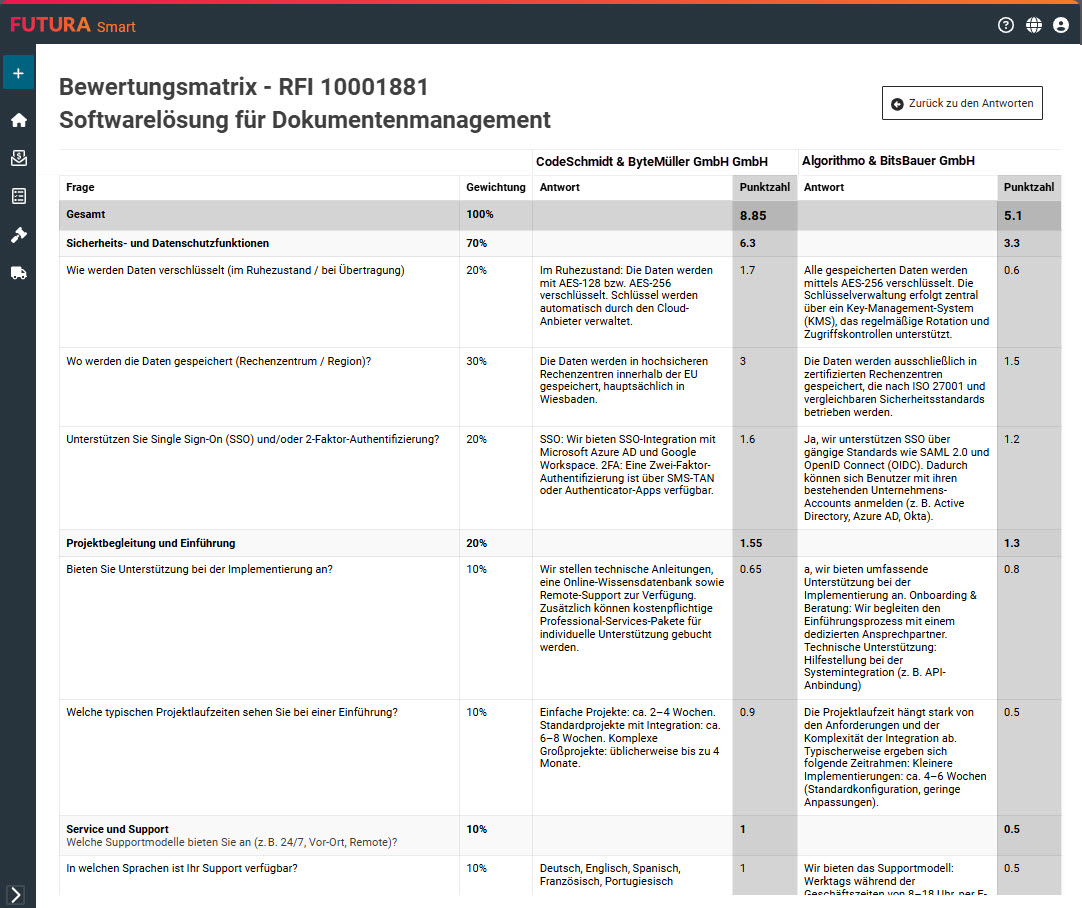
Defining and weighting criteria – from price to quality through to sustainability.
Each question or segment is given an individual weighting in FUTURA Smart, making it clear which factors are crucial in your decision matrix and utility analysis.
Use in purchasing – when is a utility analysis particularly helpful
Complex evaluation methods are not required for every request. For simple, standardized parts, a price comparison is often sufficient. However, as soon as several criteria other than price come into play – such as quality, adherence to deadlines, service, or ESG – it becomes difficult to evaluate these factors without a structure.
Added value in more complex procurements
This is precisely where utility analysis proves its worth: It makes complex decisions transparent, objective, and traceable for all parties involved. It provides a reliable basis, especially for strategically important procurements – where pure price comparisons hit their limits.
Data collection as a basis
Data collection is a key component of this process: Purchasing officers review and consolidate information from quotations, certificates, references, and service commitments. This ensures that the evaluation is based on a complete and objective set of facts – and not just on individual aspects such as price.
Typical areas of application
It is therefore particularly worthwhile in situations where several departments are involved, where quality or delivery bottlenecks pose a risk, where sustainability and compliance requirements must be taken into account, or where innovation and long-term partnerships are at stake. In such cases, utility analysis establishes clarity, traceability, and acceptance – in purchasing as well as and in management.
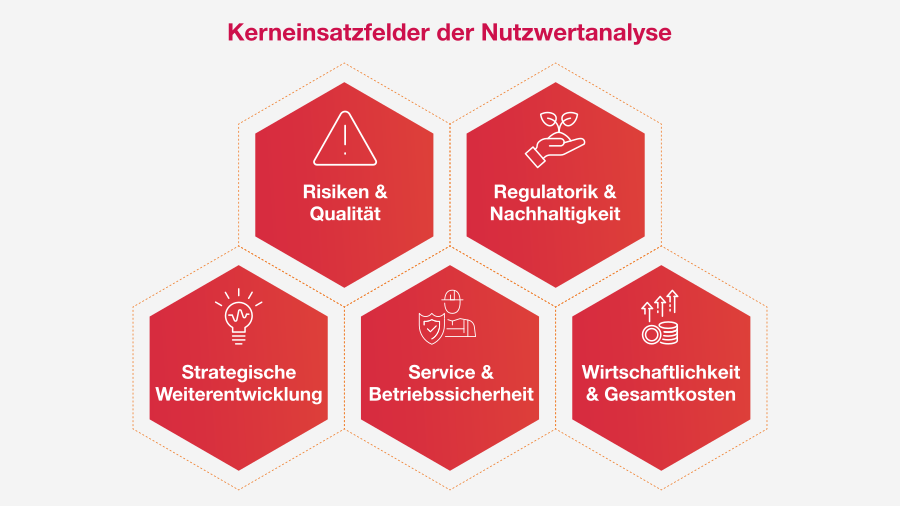
Criteria & weighting – the key to objectivity
The benefit analysis brings different criteria into a comprehensible evaluation process. It is based on two principles: uniform evaluation scales per criterion, which make the results comparable, and transparent weightings, which reflect the strategic priorities.
Typical criteria can be classified into four clusters:
- Quality: Technical performance, certifications, complaint rate
- Logistics/performance: Adherence to delivery dates, delivery capability, flexibility
- Purchasing/commercial: Price, conditions, contract and service conditions
- Further development/future: Innovation capability, ESG & compliance, cooperation potential
For example, it may make sense to give greater weight to sustainability criteria if customer requirements or legal regulations dictate this. This shows that utility analysis is not rigid, but rather reflects the individual priorities of a company.
Example of utility analysis: Selection of a strategic supplier
A company is looking for a new supplier for a safety-relevant component. Two suppliers are shortlisted:
- Supplier A: Affordable price, but longer delivery times and no ESG certification.
- Supplier B: Significantly more expensive, but reliable, certified and with a very good service structure.
In order to make an objective decision, the purchasing department carries out a utility analysis. The criteria and weightings are defined in collaboration with the specialist departments:
- Quality: 40 %
- Price: 25 %
- Adherence to delivery dates: 20 %
- ESG & sustainability: 15 %
The quotations are evaluated and entered into the model:
| Criterion | Weighting | Supplier A (points) | Supplier A (weighted) | Supplier B (points) | Supplier B (weighted) |
| Quality | 40 % | 60 | 24,0 | 90 | 36,0 |
| Price | 25 % | 95 | 23,8 | 70 | 17,5 |
| Adherence to deadlines | 20 % | 70 | 14,0 | 85 | 17,0 |
| ESG | 15 % | 40 | 6,0 | 95 | 14,3 |
| Total | 100 % | - | 67,8 | - | 84,8 |
Interpretation: Despite the lower price offered by Supplier A, the utility analysis clearly shows that Supplier B is the better partner – their advantages in terms of quality, adherence to delivery dates, and ESG outweigh the price advantage.
Conclusion: Added value in practice
Utility analysis is much more than just an evaluation method. It creates transparency, makes weightings visible, and increases acceptance among stakeholders. This makes it a reliable basis for decision-making – in projects as well as in long-term supplier development.
However, it is not the model that is decisive, but the implementation:
- 🎯 F ocus on criteria – reduce the number of factors to 4–6 that are truly relevant. Too many criteria dilute the significance and make the evaluation unnecessarily complex.
- Involve stakeholders early on – get technology, quality management or sustainability experts(Corporate Social Responsibility / CSR) on board right from the start. This creates acceptance and prevents conflicts later on.
- 📝 Secure documentation – record weightings and results in a traceable manner. Clear documentation reduces subsequent discussions and creates transparency for management, internal and external auditors.
With modern tools like FUTURA Smart, utility analysis evolves from an Excel-based tool into an integral part of a digital procurement strategy. Automated weighting, transparent dashboards, and efficient reporting make it easier to use—complemented by simulations and AI-powered forecasts regarding supply capabilities and ESG risks.
FAQ on utility analysis in purchasing
How are utility analysis and scenario analysis related?
The utility analysis provides an objective result, while the scenario analysis tests its stability when weightings change.
What role are questionnaires playing?
Supplier questionnaires provide the data basis – e. g., certifications such as ISO 9001 or ESG information. Mandatory criteria serve as knockout criteria.
Can utility analysis be used for supplier development as well?
Yes – criteria such as innovation capability or sustainability can be evaluated on a regular basis. This turns a decision-making aid into a continuous management tool.
Key takeaways
- Comprehensive evaluation instead of price comparison: In addition to price, the utility analysis also takes into account quality, logistics, service, ESG, and innovation.
- Objectivity and transparency: Through weighting and documentation, the utility analysis creates a traceable basis for decision-making – for management and auditing as well.
- Strategic added value: Utility analysis is particularly useful for complex, high-risk, or ESG-relevant requests – and it strengthens purchasing as a strategic partner.
Make the best decision – not just the cheapest one.
FUTURA Smart turns utility analysis into a strategic tool.


