What is the difference between Digital Core and Clean Core?
In short: Digital Core is the goal, and Clean Core is the rule that safeguards it.
- Digital Core: S/4HANA as the central foundation for processes, data, and document chains within the company.
- Clean Core: The principle of not burdening this SAP core with custom modifications, data copies, or unnecessary additional logic.
For procurement, this means that sourcing processes must be digitized in a way that effectively extends the SAP core system without introducing new shadow processes, data silos, or upgrade risks.


Why custom code is causing problems in purchasing today
Clean Core is the norm today – but for many purchasing organizations that use SAP, the reality is that their systems have evolved over time. SAP was already the leading ERP system back in the ECC era. But it was also highly customizable – and that capability was put to extensive use. Especially in purchasing with SAP, a multitude of custom extensions have been added to the core over the years – a key reason why S/4HANA migrations are complex and risky today.

Multi-level approval workflows: Value limits, cost centers, or hierarchies were often too inflexible in the standard system. The result: Z-programs in the core – difficult to maintain and often poorly documented.
Additional fields in purchasing documents
Project codes, product group logic, and evaluation fields were added directly to the SAP core system. They had to be reviewed with every release.
Logic for requests and quote comparisons SAP has offered various approaches to RFX processes, but no consistent standard integrated into the ERP system. In practice, this led to the development of in-house solutions – or requests were handled via Excel and e-mail.
Customized reports and analyses Standard reports were often insufficient. This led to the creation of Z-reports, which were later difficult to understand, poorly documented, and could only be customized with considerable effort.
The specific implications of Clean Core for purchasing and IT
Clean Core changes not only the technical architecture, but also the decision-making process within the company. This gives rise to different requirements in procurement and IT that need to be reconciled.
For IT, Clean Core means one thing above all else: Less risk.
- No custom modifications that need to be tested with every release
- No additional systems that need to be integrated and operated
- Clear system boundaries and controllable data flows
Every additional solution is evaluated based on whether it supports these principles – or subverts them.
For the purchasing department, Clean Core means something else:
The workarounds used so far no longer work.
- In-house developments in the SAP core are no longer an option
- Excel- and email-based requests remain inefficient and cannot be audited
- Isolated solutions outside of SAP lead to data discontinities and data loss
At the same time, the need remains the same: Structuring requests, comparing quotations, and documenting contract awards – processes that requireexpanding S/4HANA.
Where S/4HANA reaches its limits in sourcing
The requirements in purchasing have not changed – but S/4HANA only partially meets them. Those migrating from ECC often bring custom code for requests and awarding with them – code that cannot be implemented in a clean-core-compliant manner. Those starting fresh with S/4HANA face a gap in the standard system: In many companies, requests, quote comparisons, and award documentation remain outside of SAP – in Excel, via e-mail, and without a consistent audit trail.
Covered by the standard S/4HANA
… what is not covered
Purchase orders

RFI, RFQ, RFP
Goods receipts
Quote comparisons
Audit
Communication with suppliers in the awarding process
Supplier master data
Awarding documentation
Operational procurement
A structured decision-making process prior to placing an order
Digitizing Sourcing: Three approaches, three outcomes
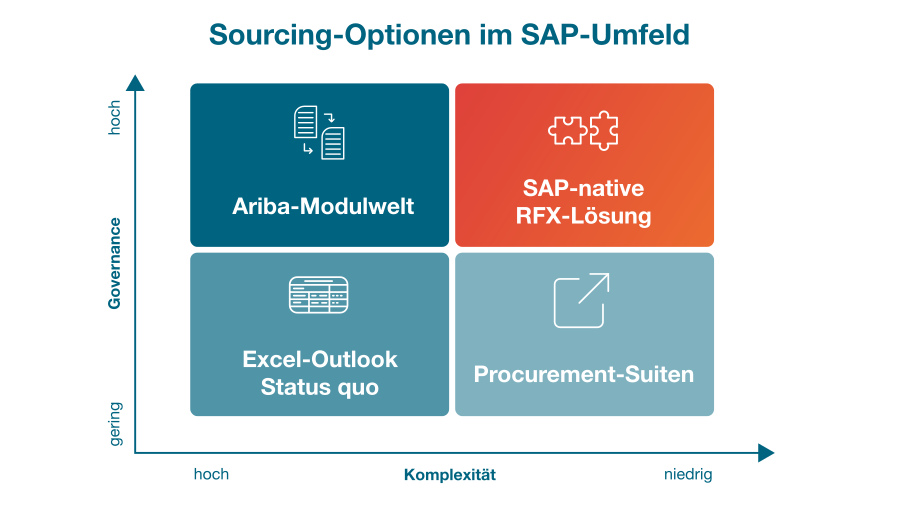
For SAP-driven purchasing organizations, the key question is how to bridge this gap: By using new custom code, an external platform, or a Clean Core-compliant, SAP-native extension.
The SAP-native approach is what FUTURA offers: RFX processes, comparison of quotations, and award decisions are mapped within the SAP environment – via OData, without middleware, and without data replication. The relevant sourcing data remains within the SAP data model: Capable of evaluation, auditable, andusable directly within the SAP environment.

In-house development within the SAP core
Closes process gaps on a case-by-case basis, but introduces new custom code, maintenance efforts, and release risks.

External sourcing platform
Provides sourcing functionality, but often creates its own data storage, interfaces, and additional system logic.

SAP-native extension
Expands sourcing via official APIs – without affecting the core system and without a parallel data model.
Background & practical applications on the blog
Between RISE, GROW, and Ariba: The unresolved gap in strategic SAP purchasing

SAP Clean Core Strategy: On why purchasing departments must make architectural decisions today

Purchasing in 2026: Four decisive factors for success
Frequently asked questions about Clean Core
What is the difference between Digital Core and Clean Core?
The Digital Core, together with S/4HANA, forms the company’s central process and data foundation.
Clean Core describes the approach to keeping this SAP core close to the standard and ready for new releases. For procurement, this means that the SAP core remains the leading system, even if additional sourcing processes need to be integrated.
Can purchasing processes be expanded despite Clean Core?
Yes. Clean Core does not prohibit extensions – it specifies how they should be implemented. Especially in purchasing, extensions are often necessary because the standard S/4HANA does not fully cover sourcing and award processes. Such extensions are Clean Core-compliant if they are implemented via official interfaces rather than by directly modifying the SAP code.
Why is customized code in the SAP core a problem today?
Custom code – or customer-specific developments built directly into the SAP core – was common in the ECC era to close process gaps. When migrating to S/4HANA, this code becomes a risk: Every Z-development must be reviewed, adapted, or removed. This prolongs migration projects and increases the risk of errors. Clean Core therefore requires extensions via approved APIs rather than through modifications to the standard code.
Does Clean Core apply only to new S/4HANA implementations or also to existing systems?
Clean Core applies to every S/4HANA environment – whether it’s a new implementation or a migration from ECC. During migrations, existing customizations in purchasing must be checked for Clean Core compliance. Customized code for workflows, requests, or additional fields cannot be carried over in its entirety and must either be phased out or reimplemented using approved APIs.
Implementing sourcing in compliance with Clean Core
How can you expand sourcing capabilities in your SAP environment without compromising the Clean Core? During our initial consultation, we’ll take a look together at the current state of your RFX processes, identify any data silos, and explore how to seamlessly integrate requests, quote comparisons, and award decisions into your SAP environment.
Your RFX processes today – and how they can be mapped in an SAP environment in compliance with Clean Core.
The solution areas FUTURA offers for various requirements in the sourcing environment.
See firsthand how sourcing processes work in an SAP context – without media discontinuities or parallel systems.