Why Excel checklists are not suitable for supplier qualification
An Excel spreadsheet with 50 columns filled with certificates, contact details, and comments: This is the reality of supplier qualification in many purchasing departments. At first glance, it seems pragmatic: Quick to create, easy to share, and usable without major IT investment. But this solution is deceptive. Those who rely on Excel in the long term, not only run the risk of operational errors, but can also create strategic blind spots – leading to audit problems and delivery failures.
In this article, we show why Excel checklists are not a sustainable medium for supplier qualification, what risks may arise from it and how digital processes create real added value – for purchasing managers and strategic buyers alike.
Excel: Practical in everyday life, risky in supplier management
Excel is flexible and can be used quickly, but it is precisely this flexibility that makes it prone to errors. According to a KPMG study, over 90% of all Excel models contain errors, and in the case of financial models, this figure rises to 95%. The problem is that spreadsheets do not have any integrated control mechanisms, meaning that even models used for decision-making are used without systematic quality assurance.
An analysis by the Institute of Chartered Accountants (ICAEW) also shows that 90% of all tables with more than 150 formulas contain material errors. These range from simple typos and incorrect formats to omission errors where entire data or checks are simply forgotten - and it is these errors that often go undetected.
Three common pitfalls
The weaknesses of Excel checklists are evident in purchasing in various ways – sometimes in strategic management, sometimes in daily routine operations. Three pitfalls occur particularly frequently:
📑 Scattered certificates and documentation
Certificates are stored in various Excel files, and updates are easily overlooked. Expired certificates are often only discovered during audits, resulting in a high level of documentation effort and compliance risks.
💸 Financial risks remain invisible
Excel has no automatic warning signals. Critical credit rating developments are therefore often recognized too late – with direct consequences for projects, budgets, and delivery capabilities.
🤝 Stakeholders not synchronized
Purchasing, quality, and compliance each work with their own tables and have different perspectives. The lack of a shared data set leads to conflicting assessments and unnecessary delays.
The process of supplier qualification: More than just a checklist
The pitfalls show that Excel can record individual pieces of information, but does not provide a common thread. What is missing is the procedural aspect – a clear process with uniform criteria, responsibilities, and automated workflows. Only this structure can turn supplier qualification into more than just a loose checklist.
The focus is on standardized criteria such as certifications, ESG and LkSG compliance documentation, creditworthiness data, and references. When this information is consistently collected and automatically verified, it enables comparability—exactly what is missing from Excel spreadsheets. The specific criteria that are relevant depend on the industry, regulatory requirements, and risk profile.
A digital process in supplier management typically involves five steps:
1️⃣ Registration & master data
Suppliers enter their basic information including certificates. Mandatory fields and format specifications ensure that nothing is missing.
2️⃣ Checking & validation
Purchasing, quality and compliance check together. Automated checks ensure that certificates are up-to-date and correct.
3️⃣ Evaluation & Decision-Making
Consistent criteria ensure comparability. Decisions are based on data, not gut feelings.
4️⃣ Approval & integration
Only approved suppliers are transferred to the ERP (e.g. SAP S/4HANA) – without manual duplication.
5️⃣ Tracking & recertification
Deadlines, such as certificate expiry dates do not come to nothing: Workflows automatically remind users and trigger recertifications.
Unlike Excel, supplier qualification is not a static document, but an end-to-end workflow - efficient, transparent and audit-proof.

Supplier qualification with FUTURA:
Whether for market research or evaluating new partners, questionnaires—that is, digital supplier questionnaires—can be used at every stage of the supplier selection process.
Conclusion: The benefits of digital supplier qualification
Excel checklists may be a quick start, but they are not sufficient for sustainable supplier qualification. A professional process requires clear structures and digital support to ensure transparency, efficiency, and compliance.
This includes:
- Standardized questions on relevant criteria such as certificates, ESG and LkSG certificates or key financial figures.
- Standardized processes, that all suppliers must undergo – objective and transparent.
- A central database that provides consistent information at any time.
- Automated workflows that handle validations, reminders and evaluations.
- Shared data access for purchasing, quality and compliance.
- Audit-proof traceability so decisions can be verified at any time.
The advantages of digital solutions are clear. Although they require investment and change management, the ROI usually becomes apparent after just a few months – through saved audit costs, faster approvals and reduced risks.
With FUTURA, this added value becomes immediately tangible: supplier qualification processes can be mapped in a standardized yet flexible manner, evidence can be documented in an audit-proof way, and all stakeholders can be seamlessly integrated. This creates a digital workflow within the framework of structured supplier lifecycle management that finally replaces Excel—and strategically strengthens procurement.
Key takeaways
- Excel solves short-term problems, but leads to new challenges in the long term – such as different file statuses and a lack of auditability.
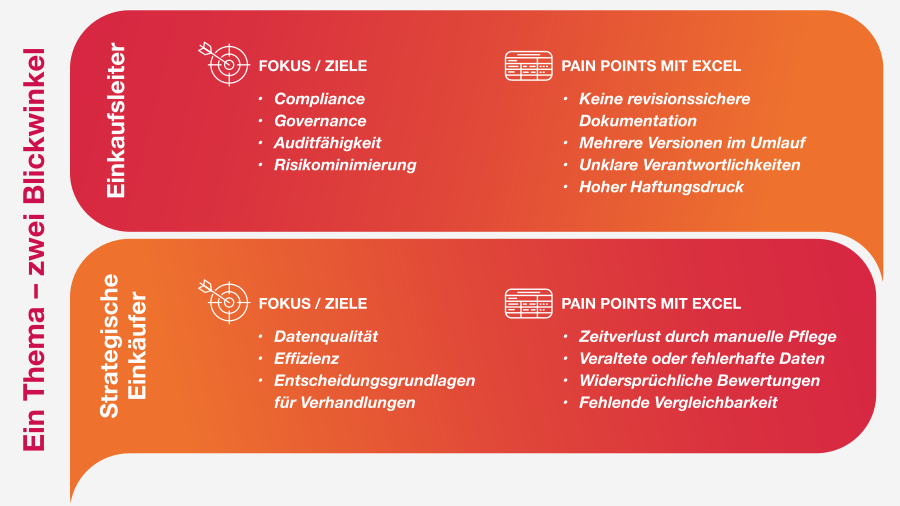
- The weaknesses have a different impact depending on the role: CPOs encounter governance gaps, purchasers encounter inefficient processes and poor data quality.
- Digital supplier qualification creates a common denominator – with clear criteria, valid data and audit-proof processes as the basis for strategic decisions.
Digital supplier qualification – efficient, transparent, audit-proof
Find out how digital workflows unite the different requirements in purchasing – and finally replace Excel.