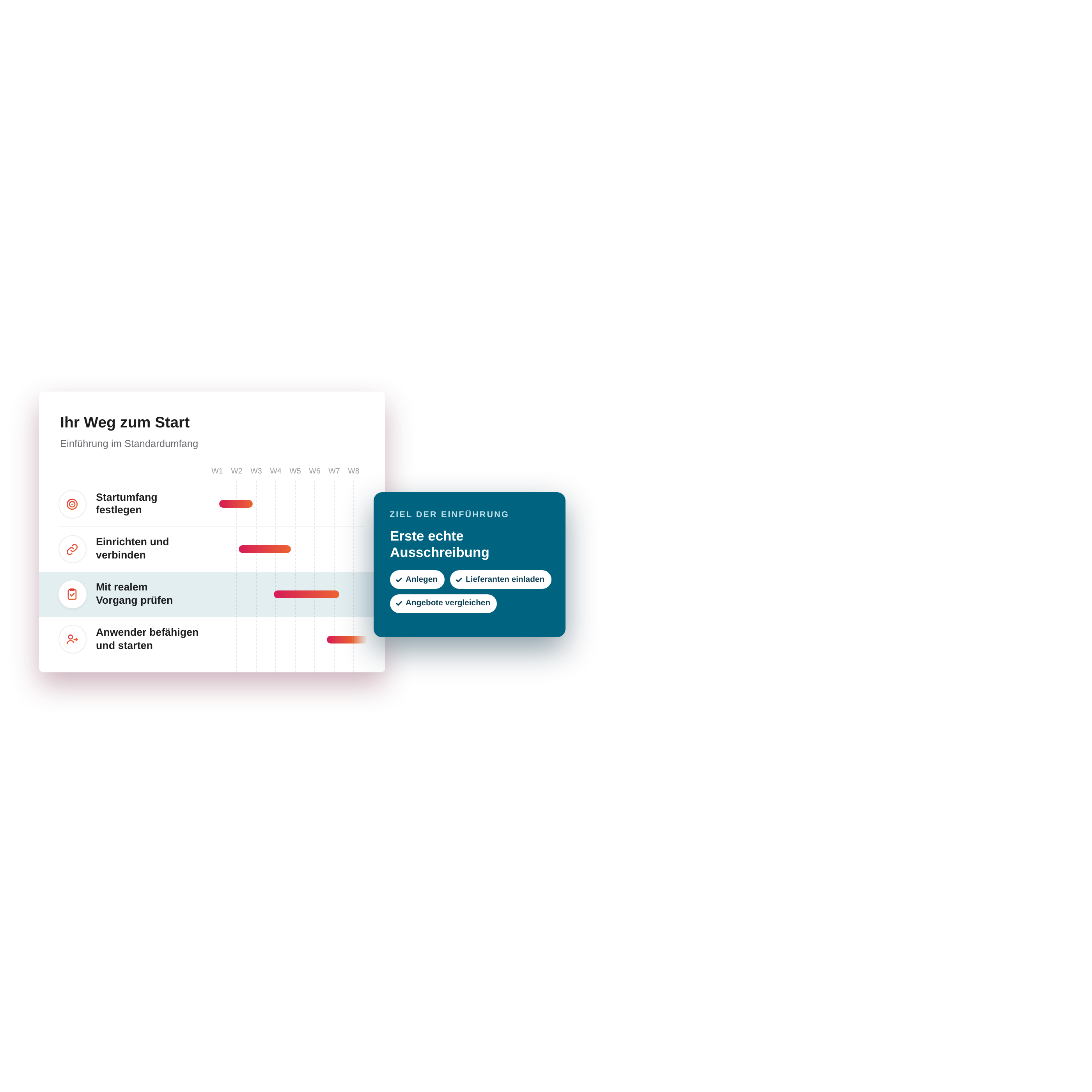
The benchmark is your first real request.
For us, “time to value” means: How quickly can your purchasing team use the solution in their daily work? The goal of the implementation is to establish an approved process in which your team can create a real request, invite suppliers, and compare quotations.

Process tested using a real procurement case
Users trained; first request prepared
Launch verified against mutually agreed-upon acceptance criteria
Additional material groups and locations will be added gradually
Why your purchasers can start earlier.
Make use of existing resources and prepare specifically for the first deployment: This reduces the time and effort required for setup, coordination, and training.
Keep using SAP data
FUTURA uses relevant master data and organizational structures from SAP S/4HANA.
These basic elements do not need to be rebuilt and synchronized in a second data model.

Your benefit: Less data preparation – your team can start working on the business process sooner.
A defined SAP integration
The SAP-native integration uses standardized SAP APIs.
As a result, fewer custom connections need to be developed and coordinated within the standard scope.
Your benefit: A manageable technical scope of work. Setup, access verification, and testing are all included in the project plan.
Set clear boundaries for the first use
You begin with a specific sourcing process, such as a request for a selected material group.
Additional locations and special cases will be planned as part of the subsequent rollout.
Your benefit: Less coordination before launch – and practical experience to build on.
Lear from a real procurement case
Testing, training, and supplier participation are based on the first use case.
Your team practices the procedure, and then uses it in its daily work.
Your benefit:Targeted training and a prepared first process instead of training without a specific use case.
A clear path.
Four phases.
Together, we’ll determine which process will go live first and what’s needed to make that happen. The specific timeline will depend on your SAP environment and the scope we agree upon.
SPECIFICATION→
Initial scope, procurement scenario, and acceptance criteria
SETUP →
Application, SAP integration, and permissions
VERIFICATION →
Test with a real procurement scenario
LAUNCH
Training, acceptance tests, and go-live

Specify the initial scope
Before the project begins, we discuss the SAP environment, the first procurement case, and the required functions – including contact persons, prerequisites, and acceptance criteria.

A coordinated plan as the basis for the 4–8 weeks

Setup and connection
The application will be set up for the specified process. Technical integration, data access, and permissions will be configured.
Functional test environment

Test with a real scenario
Purchasers and IT are testing the process using a specific scenario: From request through and supplier participation through to further processing in SAP.
Professionally and technically validated process

Enable users and get started
Involved users will receive training, and the first request will be prepared. After acceptance and go-live, your purchasing team will use the specified process.
First real request possible
What is required for the 4–8 weeks.
Four points must be clear before we begin.
Custom extensions, multiple system landscapes, or a comprehensive rollout are being additionally planned.
01
Your SAP environment is supported.
02
The first scenario has been specified.
03
The necessary accounts can be set up.
04
Purchasing and IT are available for testing and approval.
The timeframe applies to the standard version of FUTURA Smart. For FUTURA Engineering, we adapt the implementation plan based on the required construction, project, and service processes.
Manageable workload. Clear responsibilities.
The SAP-native foundation reduces the need for additional setup work. Business decisions, technical approvals, and user preparation are still required. We will collaborate to outline tasks and deadlines in the implementation plan.

Your purchasers
Contact persons Key users Procurement case Acceptance
Appoint a technical contact person. Your IT department will verify the SAP requirements, enable the specified access rights, and assist with authorization checks, technical tests, and approvals.

Your IT
SAP prerequisites Access Permissions Approvals
Please designate a technical contact person. Your IT department will verify the SAP requirements, grant the agreed-upon access, and assist with authorization checks, technical tests, and approvals.

Futura Solutions
Setup SAP integration Training Go-Live
We will assist with the setup and SAP integration within the agreed scope, coordinate the process with you, and provide support for testing, training, and going live.
One material group.
One real requirement.
An exemplary starting scope:
Your purchasing team begins with an RFQ for a selected material group. Together, we’ll determine how to recognize when the system is ready for production:

The real requirement can be processed within the established SAP context.
Authorized users can create and edit requests.
Suppliers can participate and submit bids.
Quotations can be compared and managed further in the defined follow-up process.
Additional material groups or locations will build on the experience gained from this initial use case.
Get started productively today. Expand your procurement intelligence strategically.
The first SAP-native procurement process is more than just a digital workflow: Requirements, requests, and quotations are linked to the relevant SAP data. This business context forms the foundation for procurement intelligence.
Specific analytical tasks can be built on this foundation—for example, categorizing bids, identifying discrepancies, and preparing award decisions. We’ll work with you to determine which features are available for your specific use case and how they will be implemented.
Further material groupsAdditional user groups Specific AI use case
You decide which next step is most beneficial. Existing SAP access rights and process foundations can remain in use if they are suitable for the new use case.
Less preparatory work also has an impact on costs.
A limited scope of implementation and the use of existing SAP structures can reduce the need for external project services and minimize the demand on internal resources. The total costs also include usage fees, operation, support, and future enhancements.
The total cost of ownership (TCO) analysis shows which services are included, which internal tasks remain, and what additional costs may arise for other processes or AI use cases.






FAQ on implemetation
When does the 4–8-week period begin?
It begins on the mutually agreed-upon project start date, once the standard scope has been clarified and the necessary prerequisites are in place. This does not include any prior selection or contracting phase. We will coordinate the specific timeline based on your SAP environment.
What will go live after this period?
The goal is to enable your purchasing team to conduct the first real request with FUTURA Smart, based on the agreed process. This does not automatically mean that a company-wide rollout across all locations and material groups is complete.
Why is the implementation streamlined despite the SAP integration?
FUTURA uses relevant existing SAP structures and a standardized integration. This reduces the need for additional setup and coordination efforts. Configuration, authorization checks, functional tests, and approvals are still required.
Do we need to change our existing processes?
FUTURA builds on existing SAP structures and procurement processes. We determine which processes will be adopted and which will be adapted based on the initial use case. The agreed-upon scope determines the implementation plan.
Does the same timeframe apply to FUTURA Engineering and AI applications?
The 4–8 weeks apply to FUTURA Smart in its standard scope. For use cases involving FUTURA Engineering and procurement intelligence, the scope, prerequisites, and timeline will be agreed upon separately.
Better decisions. Built on SAP.
How soon can your purchasing team begin?
Bring a specific procurement scenario and the key details of your SAP environment. Together, we’ll determine a reasonable scope for the initial phase, the level of involvement required, and the path to your first live process.

Determine a reasonable initial scope

Clarify the required level of participation

The path to the first live process