Sourcing management and its role in purchasing
Sourcing management is a core function within strategic purchasing — situated between the overarching procurement strategy (strategic sourcing) and operational execution (procure-to-pay). The process translates strategy into specific requests and ensures that decisions regarding suppliers are made on a competitive basis, are transparent, and are documented — not based on experience or availability.
Who gets invited to the request? What criteria are used for evaluation? How is the decision justified and documented? The goal is not just the lowest price, but the best overall performance — taking into account quality, delivery terms, risk, and compliance requirements.

Compliance-driven requests
(Public procurement law, regulated industries)
Re-post a request for a material group
(new requirement, new market)
Re-post requests for existing supplier contracts
(Condition assessment, competitive pressure)
Initial selection of a supplier
(no existing framework agreement)
Distinguishing sourcing management from related terms:
Strategic Sourcing
Defines the strategy: Which product groups shall be procured and how – single vs. multi-sourcing, make-or-buy decisions.
Sourcing management implements this strategy by means of specific requests. The strategy defines the “what” and “why”; sourcing management provides the “how.”
E-Sourcing / RFX Sourcing
E-sourcing refers to digital tools for procurement, while RFx management refers to the operational procurement process ( RFI, RFP, RFQ).
Sourcing management covers both – and supplements them with structured control, standardized processes, and consistent documentation across all material groups.
Source-to-Contract (S2C)
Entire process from defining requirements to signing the contract – includes sourcing management, contract negotiation, and contract management.
Sourcing management is a core function within S2C.
Procure-to-Pay (P2P)
Process from placing a purchase order through to payment. P2P implements the sourcing results operationally – purchase order, goods receipt, invoice verification, payment. Both processes must be integrated into the ERP system to ensure a smooth workflow.
Supplier Lifecycle Management (SLM)
Management of existing supplier relationships (performance, risk, development).
Sourcing management = Competitive supplier selection – both existing and new suppliers.
Procurement Management
Overall management of purchasing (strategy, sourcing, SLM, contract management, purchase-to-pay (P2P)).
Sourcing management is a subfunction.
From requirement to awarding – five phases of sourcing management
Sourcing management organizes the supplier selection process into five sequential phases – from defining requirements to the award decision.

Analysis of requirements & market analysis
Assessing requirements and analyzing the supplier market. What is needed, in what quantities, based on what specifications – and which suppliers are suitable?

Service specification, list of suppliers, market assessment

Request
(RFI/RFP/RFQ)
Formulate requirements, define evaluation criteria, and invite suppliers to submit quotations. Depending on the complexity: RFI (request for information), RFP (request for proposal), or RFQ (request for quotation).
Sent requests, defined evaluation criteria, submission deadline

Comparison of quotes &
evaluation
Submitted quotations are evaluated according to defined criteria – price, quality, delivery terms, and risk. The goal is a structured, transparent comparison.
Completed evaluation matrix, quote summary, ranking

Award decision & negotiation
Based on the evaluation, a decision is made, documented, and approved internally. Negotiations with the preferred supplier follow if necessary.
Award decision, negotiation records, internal approval

Supplier selection & contract signing
The selected supplier is bound by contract. Depending on the type of procurement: Framework agreement, individual purchase order, or inclusion in the supplier database.
Qualified supplier, signed framework agreement or purchase order, supplier added to the supplier database
Benefits of structured
sourcing management
Organizations that conduct requests based on uniform standards and defined evaluation criteria achieve measurably better results. The key benefits of structured sourcing management are:

Lower purchase prices through genuine competition
According to BME case studies, structured supplier competition based on uniform evaluation criteria results in purchase prices that are, on average, 8–15% lower than those resulting from direct awards without a competitive bidding process.

Reduction of maverick spending
Clear process guidelines and defined procurement thresholds reduce uncontrolled direct purchases outside of established processes and sustainably increase the spend under management.

Compliance and audit readiness
A complete award documentation complies with the requirements of the Supply Chain Due Diligence Act (LkSG), the CSRD reporting requirements, and industry-specific procurement regulations (VOB, VOL, GAEB).

Shorter processing times thanks to standardized processes
Standardized templates, predefined evaluation matrices, and clear approval processes reduce the administrative burden of each request — and make the process scalable, regardless of whether 20 or 200 requests are issued each year.

A solid data foundation for supplier lifecycle management
A structured selection history, documented evaluation criteria, and transparent award decisions form the basis for a robust supplier evaluation within the ongoing supplier lifecycle process.
Measuring sourcing management – relevant KPIs

Process efficiency
- Time-to-source:
The time from defining requirements to contract awarding. This measures whether processes are standardized or whether each request is organized individually.
- Processing time per request phase: Where do delays occur – in the analysis of requirements, the comparison of quotations, or the award decision?
- Percentage of requests compliant with regulations: Were defined process standards adhered to – the same templates, the same criteria, and a complete justification for the award?

Quality of competition
- Spend Under Management / Request rate: How much of the procurement volume goes through the structured sourcing process – rather than being a direct order or maverick spending?
- Number of quotes per request:
How many suppliers actually participate? Low numbers indicate obstacles.
- Percentage of new suppliers:
What percentage of requests include new suppliers? This indicates whether competition is truly open.
- Cost savings through competition: The difference between the initial quote and the final contract price.
The Challenge: ERP integration in sourcing management
In most organizations, sourcing management is treated as a question of tools: What software do we use for requests? The real weak point lies elsewhere — in the connection between the sourcing process and the ERP system.
The sourcing result — supplier, terms, and justification for awarding the contract — has no value unless it transitions seamlessly into operational processing. The process is only complete when the purchase order, goods receipt, invoice verification, and payment follow seamlessly.
A lack of integration between the sourcing process and the ERP system is evident in three areas:
Inconsistent data:
Supplier master data (bank account information, tax ID, terms and conditions) exists in two systems – changes must be updated in both systems, which leads to synchronization errors.
Transfer errors:
Sourcing results (price, terms, supplier) are manually entered into the ERP system – typos, outdated versions, incorrect prices in framework agreements.
Fragmented evaluation:
The reasons for award decisions and evaluation history are stored outside the ERP system, while operational data is stored within it. Strategic management — determining which supplier was selected in which material groups and under what terms — is not possible because the database is structurally divided. During audits, this means consulting two systems, manually consolidating data, and explaining any gaps.
Sourcing management in the context of SAP
For companies implementing sourcing management in an SAP environment, there are two common approaches — each with different feature sets and integration capabilities.
RFQ “Internal sourcing request”
In SAP S/4HANA, requests can be mapped via the MM (Materials Management) module of the “Internal sourcing request” type. This works for simple requests for quotation, but it has a structural disadvantage: Quotes are received via e-mail, PDF, or Excel and must be processed manually.
New suppliers must be fully registered as business partners in the system before they are invited to participate. This restricts competition to known suppliers before the request begins.

Source: SAP Learning – Sourcing in SAP S/4HANA: Working with Quotations
"External sourcing request" via SAP Ariba Sourcing
For more complex requirements, SAP recommends the integration with SAP Ariba Sourcing. Ariba handles the sourcing process, while S/4HANA remains the operational backbone. Quotations are collected via the platform, and the comparison of quotations is conducted digitally – but this introduces an external platform whose data must be synchronized with SAP asynchronously.
Sourcing data is stored in Ariba, and operational data in SAP: Data from both systems must be manually gathered for audits and strategic analyses.
Source: SAP Learning – SAP Ariba Integration: Analyzing SAP Ariba Strategic Sourcing Integrations
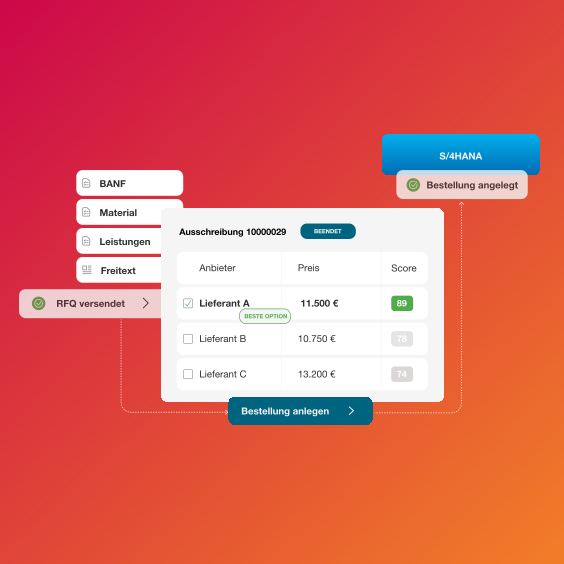
organizing competition. Closing the process.
FUTURA Smart is the SAP-native solution for structured sourcing management in SAP S/4HANA. It picks up where SAP Standard (MM) and SAP Ariba reach their respective limits: digital competition and full ERP integration within a single system.
Organizing competition digitally:
- Suppliers submit quotations directly through the integrated supplier portal – in a structured, comparable format, without a flood of e-mails or manual data entry
- New suppliers can be invited to participate in a request without having to be created in the SAP system first – competition is not limited by the absence of supplier master records
- All RFX types (RFI, RFP, RFQ) and e-auctions are integrated – whether there are 3 suppliers or 10, the process remains the same
Result embedded in the SAP core:
- Quotations, evaluations, reasons for awarding contracts – all is natively available in SAP S/4HANA, not on a separate platform
- Structured comparison options and automated quote analysis directly within the system
- Supplier master data available in real time – natively integrated into the SAP core, no asynchronous synchronization required
- Industry-Specific extensions: GAEB integration for construction – directly exchange item lists, no manual data transfer
Frequently asked questions about sourcing management
What is the difference between sourcing management and operational procurement?
Operational purchasing involves placing purchase orders, monitoring deliveries, verifying invoices, and authorizing payments – the process begins as soon as the supplier is selected. Sourcing management comes before that: Which supplier should I choose? How do I organize the competitive bidding process? How do I ensure that the selection process remains transparent?
Sourcing management is the structured selection of suppliers in competition. Operational purchasing is the day-to-day management of the relationship with the selected supplier. Both functions must be integrated into the ERP system – otherwise, there will be a discontinuity between the sourcing outcome (which supplier, under what terms) and operational processing (purchase order, invoice, payment).
How does sourcing management differ from strategic sourcing?
Strategic sourcing defines the strategy: Make-or-buy decisions, single vs. multi-sourcing, long-term supplier strategies, and risk management. Sourcing management implements this strategy at the operational level: Conducting requests, comparing quotations, awarding contracts and recording results.
Strategic sourcing addresses the following questions: What do we buy? How do we organize our supplier base? What risks do we address? Sourcing management addresses the following questions: How do I conduct a specific request? How do I ensure that the process is structured? How do I integrate the results into the ERP system?
What are the industry-specific requirements for sourcing management?
Sourcing management is similar across many industries, but certain industries have specific requirements that are not covered by standard RFQ processes.
Construction and construction projects: Requests must comply with GAEB (an XML-based exchange format for item lists). GAEB organizes construction services by trade and item (e. g., “Excavation of foundation pit, soil class 3, 450 m³”). Standard SAP and SAP Ariba do not support GAEB. Additionally, contract awards must be documented in accordance with VOB/VOL.
Services and service procurement: Performance-based procurement (not product-based) requires MM-SRV logic – service types, hourly rates, and service hierarchies instead of material numbers. Standard RFQ processes are product-centric (quantity × price), while service procurement requires a different evaluation logic (hourly rate × qualifications × availability).
Regulated industries (Energy, public clients, pharmaceuticals): Strict documentation requirements – every step must be traceable, audit-proof, and audit-ready. Fragmented processes (Excel, e-mail) do not meet these requirements.
How are sourcing management and supplier lifecycle management (SLM) related?
Sourcing management and SLM are two interrelated functions within procurement. Sourcing management selects suppliers through a competitive process, while SLM manages the relationship once the supplier has been selected — including performance evaluation, risk management, and supplier development.
The connection works both ways. The sourcing results are fed into the SLM: Who was selected, based on what criteria, and with what evaluation history? Conversely, SLM data — performance, quality, reliability — is incorporated into new requests when existing suppliers are put back into the competitive process.
Without structured sourcing management, SLM lacks a foundation: Suppliers without a traceable selection history cannot be evaluated based on a solid data basis.
What software tools are available for digital sourcing management?
The market distinguishes between standalone e-sourcing platforms (e. g. Jaggaer, Ivalua, Coupa), the standard SAP MM module, and SAP Ariba as a cloud extension. SAP Ariba offers a comprehensive set of features but requires an external platform with asynchronous data synchronization to SAP S/4HANA.
For companies that need full SAP native functionality without an external platform, FUTURA Smart offers an alternative: All RFx types, e-auctions, and award documentation directly in SAP S/4HANA — without system discontinuity or duplicate data storage.
Key Facts
- Sourcing management is the structured process for competitive supplier selection — from defining requirements to making a documented award decision.
- Sourcing management implements what strategic sourcing dictates — it translates procurement strategy into specific requests and award decisions.
- Scalable sourcing management requires four prerequisites: Uniform process standards, open supplier access, structured comparison of quotations — and a seamless transfer of the results into the ERP system.
- With 20–50 requests per year, standardization pays off: Comparability across material groups, centralized management, and scalability without compromising quality.
Implementing sourcingmManagement natively in SAP – with FUTURA
FUTURA Smart enables structured sourcing management directly within the SAP core – without an external platform and without system discontinuity. Organize supplier competition digitally, fully integrate results into the ERP system, and address industry-specific requirements.
From RFX processes to supplier evaluation and GAEB integration – how to implement structured sourcing management.
Sourcing management, supplier lifecycle management, service and project procurement – SAP-native solutions for end-to-end purchasing processes.
SAP-native architecture, Clean-Core-compliant, industry-specific differentiation – the three reasons for choosing FUTURA over SAP Standard or Ariba.