SAP S/4HANA Migration in Purchasing: MM-SRV or Lean Services with Item Hierarchies?
When migrating to SAP S/4HANA, companies must decide how they will procure and manage services and construction work in the future. The options are the traditional MM-SRV with item category D and Lean Services, whose purchase items can be structured using item hierarchies. The timeline is set: Mainstream support for SAP ERP 6.0 ends at the end of 2027, while paid extended support runs through the end of 2030. MM-SRV remains available in S/4HANA On-Premise and Private Edition. It is not available in the Public Edition, where services are mapped as Lean Services.
Migrating to Lean Services or to the SAP Public Cloud is not primarily a technical challenge, but rather a matter of business processes. This article highlights the differences, identifies what specifically can be eliminated during the transition, and provides a checklist to help with the decision.
Originally published on August 7, 2025. Revised to include an overview of functional differences and the current status of SAP maintenance periods.
Key Learnings
- Mainstream support for SAP ERP 6.0 ends at the end of 2027.
- MM-SRV remains available in the On-Premise and Private Editions, but not in the Public Edition.
- Item hierarchies organize a bill of materials, but do not replace the service level in MM-SRV.
- The transition is primarily a matter of process: A successful GAEB import does not necessarily mean that change orders and billing will work.
What changes will the transition bring to purchasing?
When migrating to S/4HANA, two decisions must be distinguished: Which SAP operating model will be used, and which data model supports the required service processes? The first decision determines which options are even available for the second.
In the On-Premise and Private Editions, existing MM-SRV processes can continue to run. A switch to Lean Services is possible but is not required by the migration. If you choose the Public Edition, only Lean Services—which can be structured using Item Hierarchies—are available for service procurement and processing.
It makes sense to make a decision on a per-procurement-process basis. A recurring maintenance contract with a fixed scope of services has different requirements than a construction contract, the scope of which changes during execution. This particularly affects companies that:
- Procure services or construction work,
- work with specifications,
- Exchange GAEB files,
- Use MM-SRV with position type D.
What does line item type D offer in MM-SRV?
SAP MM-SRV is the standard component for procuring external services. It maps service specifications with service lines to purchase order line items of item type D.
This creates a complete scope of work—with its own structure, quantities, and prices for each service line—under a single order line. Additional services can be added within the same order. The original order and any amendments thus remain in a single document.
This is what FUTURA Engineering is built on: The application processes GAEB files and integrates tenders, suppliers’ supplementary bids, updates to SAP purchase orders, and item-level service tracking all the way through to billing.
What are item hierarchies in S/4HANA?
Lean Services represent services at the purchasing line item level. Item hierarchies organize these line items using grouping elements known as item sets. They enable a hierarchical structure for purchasing documents, for example, with titles and subtitles (SAP Help Portal).
The structural difference from MM-SRV: In Lean Services, there is no service level below the purchase order line item. Each line of a service specification becomes a purchase order line item in its own right. Item sets define the structure, and all subsequent processes—such as service entry and invoice verification—are based on these purchase order line items.
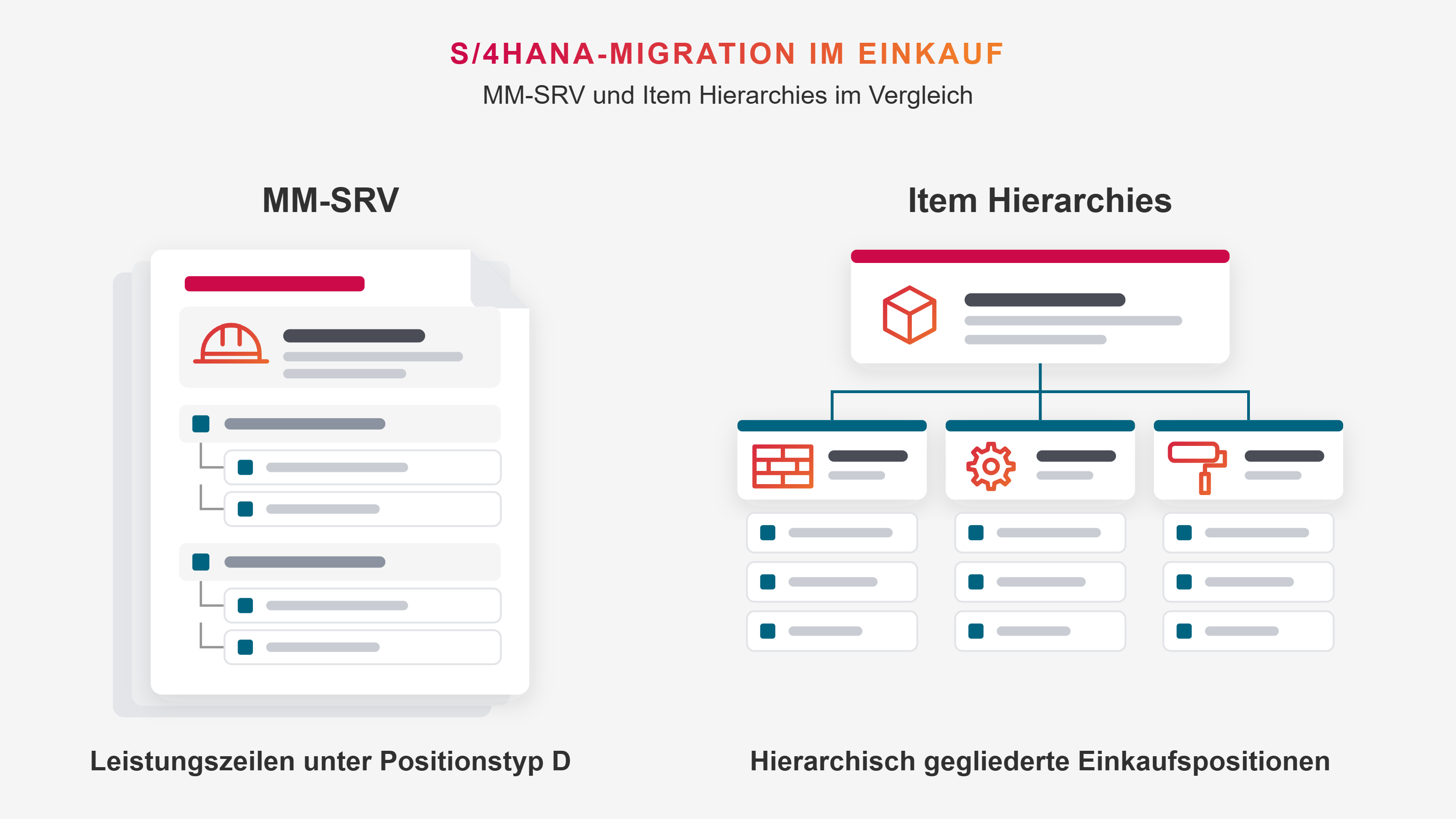
The following comparison shows the two SAP data models and how FUTURA complements them:
| Point of comparison | MM-SRV | Lean Services with Item Hierarchies |
|---|---|---|
| Performance Level | Service lines under a D order item | No separate level; each LV line is a purchase item |
| Outline | Structure within the Statement of Work | Item sets organize the purchase line items |
| Addenda | Addition to the same order; update using FUTURA Engineering | Additional line items or orders; assignment to the original order must be arranged separately |
| Service Tracking | Aligned precisely with the line items in the bill of quantities | For the purchase line items in the order |
| GAEB with FUTURA | Import, Add-ons, and Processing with FUTURA Engineering | Import, Tender, and award with FUTURA Smart; Transfer to the Item Hierarchy |
| Availability | On-Premise, Private Edition | On-Premise, Private Edition, Public Edition |
Our article, “GAEB Construction Bids with Lean Services and Item Hierarchies,” describes how FUTURA Smart processes GAEB bids in this model.
What Might Be Eliminated When You Switch
The structure of a bill of materials can be easily replicated using item hierarchies. More critical are the functions in MM-SRV that are linked to the work item line. For each affected process, it should be clarified whether and how these points are mapped in the target model:
- Line Types in the Bill of Quantities: MM-SRV distinguishes between basic, alternative, and on-demand items within the bill of quantities. GAEB tenders regularly use this distinction.
- Unplanned Work: In MM-SRV, you can set value limits for work that has not yet been specified in the order. For construction contracts, this accommodates minor additional work without requiring an immediate change to the document.
- Addenda in the Same Document: In MM-SRV, the original order and addenda remain in a single purchase order. With Lean Services, additional line items or purchase orders are created, and their assignment to the main order must be managed separately.
- Precise Service Item-Level Data Entry: In MM-SRV, quantity takeoffs and service reports are based on individual service lines. With Lean Services, data is entered at the purchase item level, which increases the volume of documents and the maintenance effort for large service specifications.
- GAEB Content During Transfer: Serial numbers, long texts, surcharges, and flat-rate items must be assigned a place in the item hierarchy. The SAP target model—not the GAEB file—determines which information is retained.
For standardized services with a consistent scope, these factors often have little impact. For construction and maintenance contracts that involve ongoing changes, however, they are crucial. Our article on change order management in SAP S/4HANA explains how this affects a specific construction contract with multiple change orders and how you can test it before migration.
Checklist for Decision-Making
Before deciding on a data model, the procurement, IT, and business departments should work together to clarify the following points:
1️⃣ Operating Model: What operating model is planned, and which existing MM-SRV processes are affected by it?
2️⃣ Functional requirements per process: Which specifications, addenda, and billing functions are actually used for each procurement process?
3️⃣ Legacy Data: How are open orders, specifications, and contracts transferred? Ongoing construction contracts with open amendments are particularly critical.
4️⃣ GAEB Transfer: Which specifications information is retained during the transfer to SAP, and which is not?
5️⃣ End-to-End Test: Walk through a typical order from the request for proposal through a supplement to billing in the target system—not just the import. You can find a specific test scenario in the article on addendum management.
6️⃣ Training: Prepare the purchasing department, functional areas, and construction management early on for changes in processes and finishes.
What this means for your decision
Ultimately, the choice is a process-based decision, not a technical one: the operating model and data model should be aligned with the processes, not the other way around. Those who primarily put standardized services out to bid and award contracts can work effectively with Lean Services and Item Hierarchies, even in the Public Edition.
Companies that manage construction contracts—including ongoing changes and addenda—all the way through final settlement in SAP are better served by MM-SRV in the On-Premise or Private Edition. For these companies, construction project management should be a key consideration early in the decision-making process regarding the Public Edition.
Which solution is right for your service process?
The key factor is whether you simply put the project out to bid and award the contract, or whether you need to track the project—including changes and addenda—through to final billing.
Construction Management Based on the MM-SRV Model
FUTURA Engineering integrates the entire process—from requests for proposals and supplementary bids to updating SAP purchase orders and item-level service tracking—all the way through to billing. GAEB compliance included.
Sourcing with Lean Services and Item Hierarchies
FUTURA Smart complements Lean Services and Item Hierarchies in sourcing and processes GAEB service specifications. Focus: Tendering and award.
Please bring a scope of work and a typical change request. Together, we’ll examine how tendering, supplement , and billing fit together in your SAP environment.

Architect, founder, and managing director of Futura Solutions. Consistently process-oriented and practical: In my blog, I focus on developments and purchasing topics related to SAP-based purchasing.
Also interesting