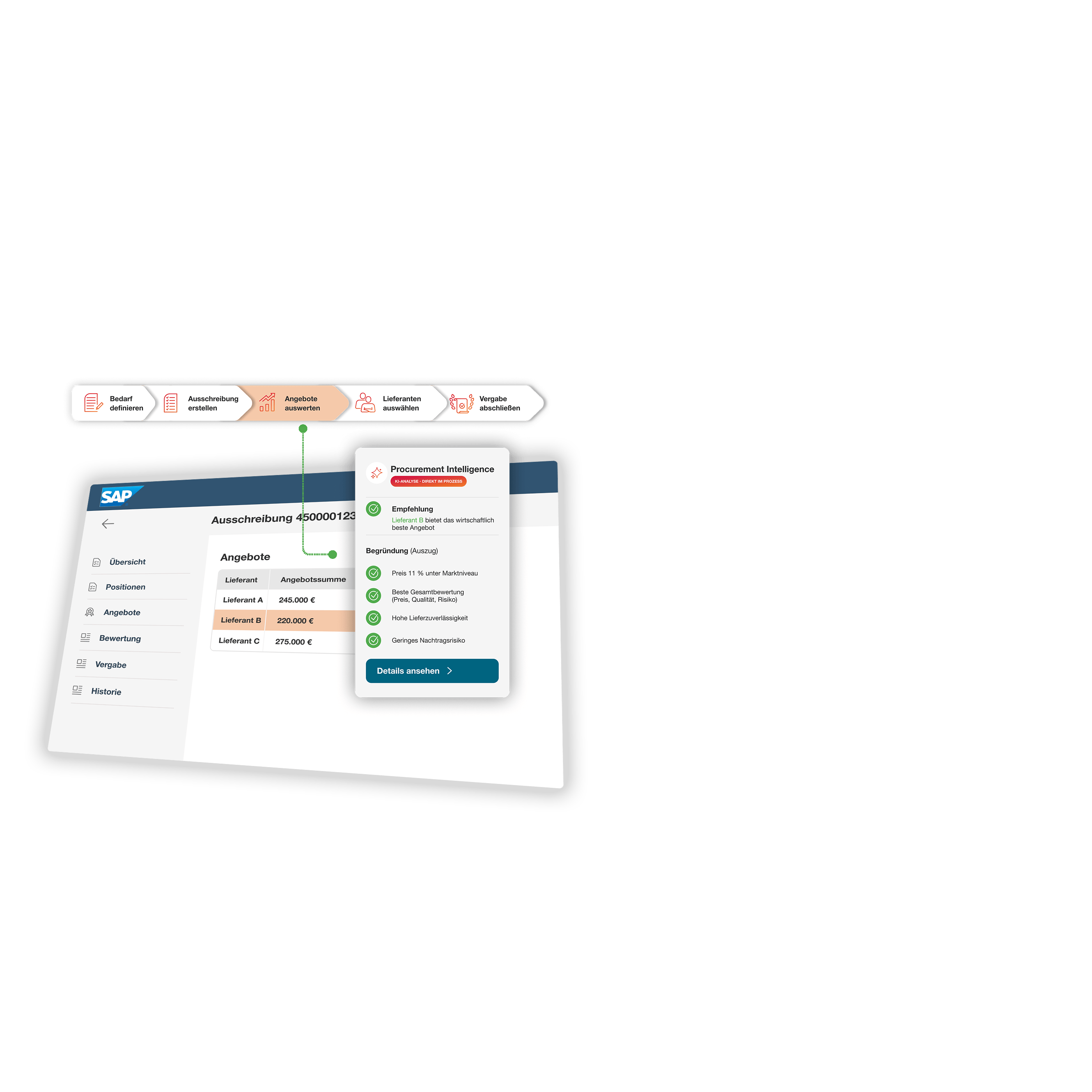
Procurement Intelligence is the ability to make decisions during the ongoing procurement process.
In a specific awarding process, prices, contracts, quotations, supplier evaluations, and internal guidelines are scattered across various sources. The typical approach for AI initiatives in procurement therefore involves consolidation, cleansing, and governance — often over the course of months, before the first results materialize. Procurement Intelligence starts one step earlier and uses the context right where it is generated and managed: Within the ongoing process.
An AI assistant answers questions. Procurement intelligence prepares decisions and executes them once they are approved.
AI assistant

Processes provided information on a case-by-case basis
Can summarize or compare documents
Usually stays outside the leading process
FUTURA procurement intelligence

Works within a specific procurement case, involving the transaction, supplier, material, contract, history, and rules
Evaluates information within the specialized context of requirements, criteria, conditions, and procurement logic
Operates natively within the SAP business context. Actions occur in a controlled manner within the process.
A practical procurement scenario: The supplier is asking for an 18% increase. What the procurement department needs to do now.
Current process
Gather contract data and terms from SAP
Manually estimate the materials involved and their quantities — often only the main material
Review the price history in Excel
Check term statuses individually by plant and contract — scales, validity periods, special agreements
Research market indices; set the time period and the benchmark
Prepare results as a presenation for the negotiation
After the agreement: Update the terms in SAP again
WORKLOAD: 1–2 days

What is subsequently missing: A clear rationale for the decision that can still be reviewed six months later.
Process with FUTURA

Calculate volume and scope
Derived directly from the SAP context, you can see which materials, purchase orders, quantities, plants, and volumes are affected by the price increase.

Merge context
Pricing history, terms and conditions, contract duration, and supplier performance are combined to provide a comprehensive basis for decision-making.
Analyze and explain the deviation
A comparison with relevant trends in market, energy, and transportation costs reveals which portion of the price increase is justified – and which is not.
Decide and act
Changes to terms and conditions, validity, approval, and reasoning are implemented and documented directly within the transaction.
TIME AND EFFORT: Hours Instead of Days

The result: The decision regarding the transaction — including data, reasoning, and approval — will be just as verifiable in six months as it is today.
Procurement expertise becomes a set of reusable skills.
FUTURA breaks down specialized procurement expertise into clearly defined capabilities.
Each one fulfills a specific task. Together, they can be combined to address an ever-changing range of procurement decisions.
Developed once. Reusable again and again.

Understand
Record requirements, documents, quotations, and procurement items in accordance with technical standards.

Assign
Assign information to the correct transaction, supplier, criterion, or business object.

Compare
Make quotations, prices, terms, services, and historical information comparable.

Evaluate
Apply business rules, methods, evidence, and procurement expertise to the specific context.

Explain
Provide clear and transparent explanations for variances, risks, and valuation results.

Recommend
Derive actionable recommendations and decision-making suggestions based on the context.
The same capabilities can be applied to continuously new use cases.
Procurement Intelligence is not a collection of isolated AI features. Capabilities are recombined depending on the procurement scenario. A new capability is not created solely for a single use case; it is immediately available in FUTURA Smart and FUTURA Engineering without the need for duplicate development.

Your AI infrastructure.
Our procurement intelligence.
If your company has already decided which AI models may be used, that decision remains the guiding principle. FUTURA is designed to be independent of specific models: You determine which approved models or Enterprise AI gateways shall be used for which purchasing tasks.
Technical capabilities and the procurement context stay the same – even if the model changes, the procurement logic remains: We call this "controlled openness".

Every decision lays the foundation for the next one
Most analytical tools produce a result. That result ends up in a presentation or a report and is no longer available to inform the next decision.
In FUTURA, the result remains within the process: Evaluation, reasoning, approval, and award are all part of the same document. The context available for decision-making grows with each actual result.

01 Understand the data
What does this price claim include?
FUTURA consolidates all relevant information related to procurement: Contract terms, purchase orders and price history, quantities, quality of materials, supplier performance, complaints, and current market information.
The new price is not considered in isolation, but rather in the context of the contract, the service, and the market.
02 Recognize potential
The discrepancy becomes apparent.
FUTURA identifies that Plant A pays 12% more for the same grade of steel than Plant, even though both obtain it from the same supplier. This reveals potential for bundling and negotiation.
A price claim becomes a deviation that can be specifically explained.
03 Prepare for a decision
WHICH OPTION MAKES ECONOMIC SENSE – AND WHY?
The purchasing department gains a transparent basis for decision-making: Price comparisons, volume potential, contract data, supplier evaluations, and market benchmarks. The final decision rests with the purchasing department.
Not just a suggestion, but a well-founded option for bundling, renegotiation, or a request.
04 Initiate measures
The recommendation becomes a planned next step.
The purchasing department decides whether to renegotiate, issue a request for a bundled quantity, or bring in additional suppliers. This well-founded decision forms the basis for the subsequent sourcing process.
This insight doesn't end with a report or chat, but leads to a controlled sourcing initiative.
05 Conduct sourcing
Quotations are presented in a structured, comparable way.
The request is part of the ongoing sourcing process. Quotations from established and new suppliers are recorded in a standardized manner, evaluated based on defined criteria, and prepared for awarding.
The process remains transparent — from the request through to the final decision.
06 Feed back the result
The decision takes effect in the SAP context.
New terms and conditions, contracts, or updated supplier evaluations are documented in the SAP system and made available for subsequent purchase orders and procurement transactions.
07 Measure the impact
New evidence emerges from the results.
FUTURA shows whether the expected outcome has been achieved: For example, in terms of prices, supply security, or on-time delivery. This information is then incorporated into the next decision.
Procurement Intelligence doesn't end with awarding. It improves with every actual result.
FAQ – Frequently asked questions about procurement intelligence
What is procurement intelligence?
Procurement intelligence combines SAP and procurement context, expertise and AI to enable better purchasing decisions. This generates actionable insights, assessments, and recommendations directly within the procurement process.
What role does SAP play?
A significant portion of the company’s operational context is already embedded in SAP S/4HANA. FUTURA works directly with it, rather than first setting up a separate environment of procurement data. This shortens integration paths and maintains clarity in data and process ownership.
Does this require that all data be consolidated centrally?
No. The key is not a central data repository, but rather controlled access to the specific context needed in each case. Data and business logic remain in their respective systems and applications.
We already had an AI pilot. Why would it be any different this time?
Pilots rarely fail because of the model itself. They fail because a separate data set is created for the test, which no one maintains during regular operations, and also because the results end up outside the decision-making process. FUTURA does not treat procurement intelligence as a collection of individual AI features, but rather as the interplay of reusable technical capabilities that all operate within the same qualified procurement context.
Do we need our own AI expertise or an AI project for this?
No. Procurement intelligence is part of the sourcing solution; it is not a separate initiative. It requires neither a separate model selection nor an additional integration process.
Is FUTURA procurement intelligence tied to a specific AI model?
No. FUTURA Procurement Intelligence is designed to be independent of any specific model. Its architecture is built to integrate AI models provided by FUTURA as well as those approved by the customer, or enterprise AI gateways. Customer-specific requirements determine which models may be used for which capabilities.
What is the advantage of the capability approach over isolated AI use cases?
In an isolated AI use case, data access, business logic, and workflows are often designed specifically for that particular case. For the next use case, much of the work has to restart from scratch. FUTURA separates business capabilities from individual use cases: Capabilities use the already established procurement context and are recombined as needed for each task. The only elements that need to be added are those still missing from a business perspective. In this way, each use case contributes to building a foundation that can also be used for future decisions.
Which purchasing decision would you like to start with?
Let's talk about your procurement case

Hartmut Schwadtke
Managing Director
Connect with me onLinkedIn at
.

Your specific use case and the current approach
The Role of SAP context, procurement expertise, and AI in this process
Time for your questions

About 30 minutes, no sales pitch
Schedule a conversation
By submitting this form, you consent to the storage and further processing of your personal data by Futura Solutions in accordance with our privacy notices.