
AI in Procurement: If You Get the Architecture Wrong, You’ll Scale Your Problems
Workloads are growing, teams remain the same – and technology is expected to bridge the gap. According to the Einkaufsbarometer Mittelstand 2026,, nearly 70 percent of companies are using, testing, or planning to use AI in procurement. The operational reality is more sobering: Only 6 percent rate their AI implementation as well-developed. This shows that the bottleneck isn’t solely due to the technology. What matters is whether AI in procurement encounters structures that make reliable results possible in the first place. The answer lies in the data architecture – specifically in the quality of system integration: Whether procurement processes run within the core ERP system or outside of it.
Key takeaways
- AI in procurement refers to the use of AI capabilities in procurement processes—from bid analysis to supplier scoring. Whether these capabilities can be used effectively does not depend on the tool, but rather on the underlying data architecture.
- Most purchasing organizations don’t have a data gap; they have a data silo problem: Data is generated separately in the ERP system, in email inboxes, and in spreadsheet – and AI can’t reliably work with that.
- AI is often expected to solve problems where rule-based automation falls short – yet both rely on the same foundation: Structured processes and consistent data.
Why AI Projects Get Stuck in the Pilot Phase
The pressure is there – and so is the industry’s response: Buy tools, implement them, and get started. The problem rarely lies in the implementation phase. The costs for licenses and implementation are predictable, and the benefits sound compelling. The risk becomes apparent afterwards – when AI runs without a clear use case and without a robust data foundation. Proof-of-concept follows proof-of-concept, and the transition to production is slow. Why is that?
The four most common reasons why AI is holding back procurement:
➡️ AI without a business context: Complexity without added value
AI is often treated as a universal solution, especially in areas where rule-based automation reaches its limits. The expectation is that AI can achieve what automation could not. What is often overlooked, however, is that both rely on the same foundation: structured processes and consistent data. Without these, automation fails. And AI will face the same problem, only with greater effort and higher expectations.
➡️ Expectations Too High, Too Soon: The Limits of Automation
Automation reduces manual tasks, shortens turnaround times, and lowers operational costs. The most significant efficiency gains are achieved in highly standardized procure-to-pay processes. AI is already being used productively in these areas—for example, in automated invoice verification or the automatic placement of orders for C-items.
However, fully autonomous procurement remains a future scenario. The reason lies in the structure of many procurement decisions. While transaction-based processes follow clear rules, strategic procurement requires complex trade-offs between price, risk, quality, and delivery capability. A robust process framework is crucial for this.
Even automated decision-making models can’t get very far without a consistent data foundation—data quality remains the key bottleneck. AI needs defined workflows as input. When requests for proposals are sent via email and award decisions are made in an inbox, AI has no process to build upon—only documents.
➡️ The Real Problem: Data Isolation Instead of a Data Gap
Most procurement organizations don’t have a data gap—they have an isolation problem. Data isolation means that the data is usually available, but scattered across various systems: ERP, spreadsheets, third-party systems. AI cannot reliably consolidate scattered data—that is the job of the architecture, not the model.
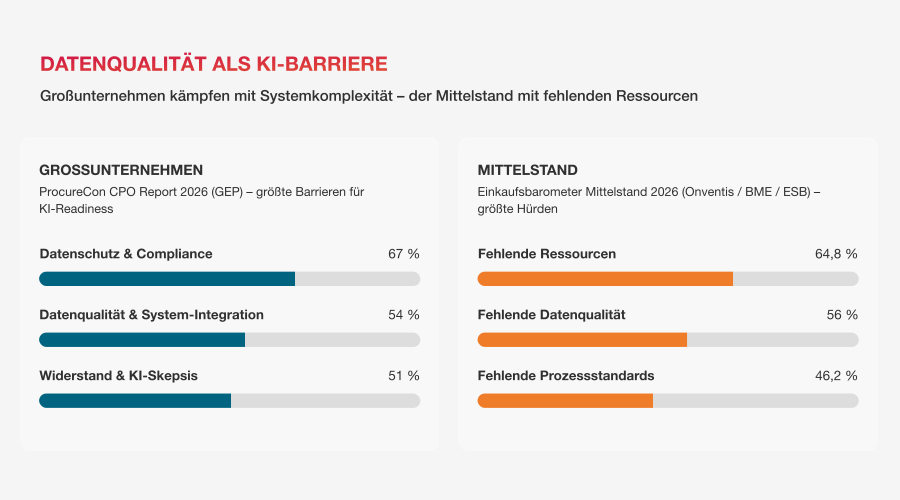
What recent studies on AI in purchasing show is revealing because they describe different causes yet all reach the same conclusion.
- When it comes to larger organizations, the ProcureCon CPO Report 2026 ( GEP) paints a revealing picture: Data protection and compliance top the list at 67 percent, ahead of data quality and system integration (54%). For larger organizations, data quality is not the top priority; rather, it is the regulatory framework — which is essential for ensuring that AI implementation is legally and organizationally sound.
- The situation is different in medium-sized businesses: According to the Einkaufsbarometer Mittelstand 2026 (Oventis, BME, ESB Business School), poor data quality ranks high at 56.0 percent, but the top concern is a lack of resources (64.8%). It is not system complexity that is holding things back here, but rather a lack of capacity for the groundwork that makes AI possible in the first place.
The barriers vary, but the result is the same: AI cannot reach its full potential as long as compliance, data structure, and system architecture are not considered as a unified whole. AI data quality is not a project—it is a characteristic of data architecture and is therefore crucial to AI readiness.
AI readiness: Current approaches and their limitations
“AI readiness”is a widely discussed term in the industry. It refers to a procurement organization’s ability to operate AI functions productively. At the structural level, four common approaches can be identified based on the available research.
Four common approaches to AI readiness in purchasing
| Approach | Core | Our assessment |
|---|---|---|
| Data maintenance and governance | Traditional consulting logic with data governance programs, master data management projects, and master data cleansing. | Time-consuming, expensive, and, above all, it treats the symptoms rather than the cause. |
| Platform consolidation outside the ERP system | All processes are migrated to an external suite with centralized data storage within that platform. | The in-house data model exists outside the core ERP system. Synchronization efforts and media discontinuities between systems remain. |
| Data lakes / AI layer | Data from various sources is aggregated and analyzed using AI — a more modern approach with greater analytical depth. | Aggregates data from various sources — but requires additional governance processes for data quality, which in turn consume time and resources. |
| Process intelligence + agents | An operating system that provides real-time visibility into spending, supplier performance, and risks, combined with active agents that feed data directly back into the workflow. | This approach requires that the core data is already structured, implying that there is a common data model at the source. |
All four approaches have one thing in common: They attempt to solve the data problem after the fact – through maintenance, migration, aggregation, or intelligent overlay. And they all follow the same consulting logic: First identify the problem, then choose the appropriate technology. This falls short because, ultimately, the issue isn’t which tool fits which problem, but where in the system the data is actually generated.
A market in transition – a realignment
In the BIP eSolutions Report 2026, Fabian Kittel of the amc Group describes a clear market trend: a shift away from isolated suites toward platforms with a shared data model. Connectors link systems, and AI layers handle processes without the need for complex implementation—the front end is becoming less important.
Architecture, implementation, and usage are undergoing fundamental changes: AI is challenging the traditional model for implementing procurement solutions. Instead of relying on standard setups, companies are exploring whether to connect systems via AI layers that control processes in the background, as outlined in the article“Procurement Without a Front End: How AI Is Reshaping eProcurement.”
The bottom line is this:
What matters most is no longer the interface, but rather who makes data continuously available and identifies patterns.
The quality of the system integration is what determines success, even without complex implementation.
AI features and agents are increasingly becoming the norm. What makes the difference isn’t the tool – it’s whether its results can be interpreted within the right process context: Existing contractual relationships, strategic supplier roles, internal approval processes, and product category strategies. It is precisely these factors that determine the quality of a purchasing decision. This context isn’t generated by the analytics tool – it resides in the ERP system.
SAP-native: Data architecture as the foundation for AI
SAP-native sourcing refers to the approach of managing procurement processes directly within the SAP core – without an external platform, without data synchronization, and based on a shared data model. With this approach, SAP not only maps the transactions but also the entire context in which purchasing decisions are made: Requirements, material master data, supplier relationships, contracts, approvals, and ordering history.
What this means in practice:
✴️ No data migration, no synchronization. Master data, supplier structure, ordering history – everything is already in the system. No need for a separate import or cross-platform synchronization.
✴️ Data quality as an outcome of the data architecture. Every request, every quote comparison, and every award automatically generates structured data – not as a side project, but as a natural outcome of the process step.
✴️ AI readiness – SAP-native. SAP-native AI in procurement refers to the approach of running AI functions directly within the SAP core – without an external platform, without data synchronization, and based on the common SAP data model. The difference from external AI layers is that AI data quality is not achieved through post-processing, but rather as a structural outcome of the process itself.
FUTURA Smart puts this approach into practice: SAP-native, strategic sourcing, without a separate platform and without the need for integration. If you’d like to see exactly how this works in your SAP environment, we’ll gladly provide a live demonstration.
Conclusion: The advantage emerges prior to the AI tool
The real competitive advantage does not come from the ability to analyze data. It comes from the ability to understand the business context – and to translate that context into better decisions
AI functions are rapidly becoming standard: Quote analysis, risk assessments, and supplier scoring will increasingly be available on every platform. What remains unique is a company’s specific context – its supplier relationships, approval workflows, and strategic priorities.
The direction in which Procurement Intelligence is evolving is already becoming clear: Instead of automating individual functions, entire decision-making processes are being automated – from requisition note to contract awarding. AI does not merely handle the analysis; it becomes an active part of the process. Those who want to take this step do not need a better AI tool – but rather the right underlying architecture.
➡️ This article is part of a series on procurement system architecture. You can find the first part here: Sourcing processes in purchasing: When fragmentation becomes an inhibitor.
AI needs the right foundation. We’ll show you how SAP-native sourcing creates the data foundation—structured and AI-ready.